Figure 2: Capillary condensation profile
showing a sudden increase in adsorbed volume due to a uniform capillary radius
(dashed path) among a distribution of pores and that of a normal distribution
of capillary radii (solid path)
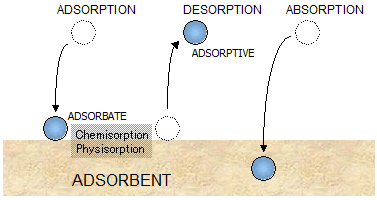
Absorption is the process in which a fluid is
dissolved by a liquid or a solid (absorbent).
Adsorption is the process in which atoms,
ions or molecules from a substance (it could be gas, liquid or dissolved solid)
adhere to a surface of the adsorbent. Adsorption is a surface-based process
where a film of adsorbate is created on the surface while absorption involves
the entire volume of the absorbing substance.
Comparison Chart
Items
Absorption
Adsorption
Definition
Assimilation of molecular species
throughout the bulk of the solid or liquid is termed as absorption.
Accumulation of the molecular
species at the surface rather than in the bulk of the solid or liquid is
termed as adsorption.
Phenomenon
It is a bulk phenomena
It is a surface phenomena.
Heat Exchange
Endothermic process
Exothermic process
Temperature
It is not affected by temperature
It is favored by low temperature
Rate of Reaction
It occurs at a uniform rate.
It steadily increases and reach
to equilibrium
Concentration
It is same throughout the material.
Concentration on the surface of adsorbent is different
from that in the bulk
Process
Gas-liquid
absorption (a) and liquid-solid adsorption (b) mechanis.
Blue spheres are
solute molecules
Adsorption and
absorption are both sorption processes.
Absorption occurs when atoms pass through or enter a bulky material. During
absorption, the molecules are entirely dissolved or diffused in the absorbent
to form a solution. Once dissolved, the molecules cannot be separated easily
from the absorbent.
Adsorption is generally
classified into physisorption (weak van der Waal’s forces) and chemisorption.
It may also occur due to electrostatic attraction. The molecules are held
loosely on the surface of the adsorbent and can be easily removed.
Uses
Adsorption: Some of the
industrial applications for adsorption are air-conditioning, adsorption
chillers, synthetic resin and water purification. An adsorption chiller does
not require moving parts and hence is quiet. In pharmaceutical industry
applications, adsorption is used as a means to prolong neurological exposure to
specific drugs or parts thereof. Adsorption of molecules onto polymer surfaces
is used in various applications such as in the development of non-stick
coatings and in various biomedical devices.
Absorption: The common
commercial uses of absorption cycle are absorption chillers for space cooling
applications, ice production, cold storage, turbine inlet cooling.
High efficiency operation, environmentally friendly refrigerants,
clean-burning fuels and few moving parts that require maintenance make
absorption a very good choice for consumers.
The process of gas absorption by a liquid
is used in hydrogenation of oils and carbonation of beverages.
Whenever a gas is in
contact with a solid there will be an equilibrium established between the
molecules in the gas phase and the corresponding adsorbed species (molecules or
atoms) which are bound to the surface of the solid.
As with all chemical
equilibria, the position of equilibrium will depend upon a number of factors :
The relative stabilities of the
adsorbed and gas phase species involved
The temperature of the system (both
the gas and surface, although these are normally the same)
The pressure of the gas above the
surface
In general, factors
(2) and (3) exert opposite effects on the concentration of adsorbed species -
that is to say that the surface coverage may be increased by
raising the gas pressure but will be reduced if the surface temperature is
raised.
The Langmuir isotherm
was developed by Irving Langmuir in 1916 to describe the dependence of the
surface coverage of an adsorbed gas on the pressure of the gas above the
surface at a fixed temperature. There are many other types of isotherm (Temkin,
Freundlich ...) which differ in one or more of the assumptions made in deriving
the expression for the surface coverage; in particular, on how they treat the
surface coverage dependence of the enthalpy of adsorption. Whilst the Langmuir
isotherm is one of the simplest, it still provides a useful insight into the
pressure dependence of the extent of surface adsorption.
Important Note - Surface
Coverage & the Langmuir Isotherm
When considering
adsorption isotherms it is conventional to adopt a definition of surface
coverage (θ) which defines the maximum (saturation) surface coverage of
a particular adsorbate on a given surface always to be unity, i.e. θmax =
1 .
This way of defining
the surface coverage differs from that usually adopted in surface science where the more
common practice is to equate θ with the ratio of adsorbate species to surface
substrate atoms (which leads to saturation coverages which are almost
invariably less than unity).
2.Langmuir Isotherm - derivation from
equilibrium considerations
We may derive the
Langmuir isotherm by treating the adsorption process as we would any other
equilibrium process - except in this case the equilibrium is between the gas
phase molecules (M), together with vacant surface sites, and the species
adsorbed on the surface. Thus, for a non-dissociative (molecular) adsorption
process we consider the adsorption to be represented by the following chemical
equation :
Whereas
pore size is a measure of the diameter of the largest pore, pore size
distribution is a measure of the range of pore sizes. The range of pore sizes
can be normally distributed, and the spread can be quite narrow (e.g. the ratio
of largest to smallest may be less than 2). On the other hand, pore size
distribution can be very heterogeneous. In the case of large spreads and
heterogeneity, the pore size will be far less predictive of flow rate (either
filtration or capillary) than it will be for a membrane with a narrow pore size
distribution. It is important to note that the pore size corresponding to the
bubble point is not at the middle of the distribution, but is the largest pore.
Zeolites are microporous,
aluminosilicate minerals commonly used as commercial adsorbents. The term
zeolite was originally coined in 1756 by Swedish mineralogist Axel Fredrik
Cronstedt, who observed that upon rapidly heating the material stilbite, it
produced large amounts of steam from water that had been adsorbed by the
material. Based on this, he called the material zeolite, from the Greek ζέω
(zéō), meaning "to boil" and λίθος (líthos), meaning
"stone".As of October 2012, 206 unique
zeolite frameworks have been identified, and over 40 naturally occurring
zeolite frameworks are known.Zeolites are widely used in
industry for water purification, as catalysts, for the preparation of advanced
materials and in nuclear reprocessing. They are used to extract nitrogen from
air to increase oxygen content for both industrial and medical purposes. Their
biggest use is in the production of laundry detergents. They are also used in
medicine and in agriculture.
The porosity of a soil depends on
several factors, including (1) packing density, (2) the breadth of the particlesize distribution (polydisperse vs. monodisperse), (3) the shape of particles,
and (4) cementing. Mathematically considering an idealized soil of packed
uniform spheres, φ must fall between 0.26 and 0.48, depending on the packing.
Spheres randomly thrown together will have φ near the middle of this range,
typically 0.30 to 0.35. A sand with grains nearly uniform in size (monodisperse) packs to about the same
porosity as spheres. In a polydisperse sand, the fit-ting of small grains
within the pores between large ones can reduce φ, conceivably below the 0.26
uniform-sphere minimum. Figure 2 illustrates this concept. The particular sort
of arrangement required to reduce φ to 0.26 or less is highly improbable,
however, so φ also typically falls within the 0.30-0.35 for polydisperse sands.
Particles more irregular in shape tend to have larger gaps between their
nontouching surfaces, thus forming media of greater porosity. In porous rock
such as sand-stone, cementation or welding of particles not only creates pores
that are different in shape from those of particulate media, but also reduces
the porosity as solid material takes up space that would otherwise be pore
space. Porosity in such a case can easily be less than 0.3, even approaching 0.
Cementing material can also have the opposite effect. In many soils, clay and
organic substances cement particles together into aggregates. An individual
aggregate might have a 0.35 porosity within it, but the medium as a whole has
additional pore space in the form of gaps between aggregates, so that φ can be
0.5 or greater. Observed porosities can be as great as 0.8 to 0.9 in a peat
(extremely high organic matter) soil.
Porosity is often conceptually partitioned
into two components, most commonly called textural and structural porosity. The
textural component is the value the porosity would have if the arrangement of
the particles were random, as described above for granular material without
cementing. That is, the textural porosity might be about 0.3 in a granular
medium. The structural component represents nonrandom structural influences,
including macropores and is arithmetically defined as the difference between
the textural porosity and the total porosity.
The texture of the medium relates in a
general way to the pore-size distribution, as large particles give rise to
large pores between them, and therefore is a major influence on the soil water
retention curve. Additionally, the structure of the medium, especially the
pervasive-ness of aggregation, shrinkage cracks, worm-holes, etc. substantially
influences water retention.
There are
t-plot, HK, SF, DR-plot, NLDFT and GCMC method for the evaluation of micropore.
t-plot and DR-plot are used to determine the pore volume and separation of internal
and external surface area of the particle. HK, SF, NLDFT and GCMC method are
used to determine the pore size distribution.
Since the
micropore analysis theories must describe the short-range interaction of
adsorbate and pore wall, it is not as easy as describing the flat surface
adsorption or mesopore adsorption. The typical assumption of these theories is
that the pore shape is a slit or cylinder. As the parameters, the surface atoms
of pore wall and adsorbate molecules must be selected (e.g. oxygen/carbon, N2/Ar). If the sample has uniform and
homogeneous pores, the calculated pore size will be accurate. However, most of
real materials have nonuniform and heterogeneous pores which are not fit to the
assumption of the theories. This disagreement is true not only for the pore
size distribution obtained from the gas adsorption but also for other
porosimetry and particle size measurement. The gas adsorption so far is the
best method for the evaluation of micropores compared to other methods because
the probe gas molecule size is below nm to detect micropores.
Our recommend
method of micropore analysis is as follows: For zeolitic materials, measure
them with the Ar adsorption isotherm at 87K and analyze by the cylindrical pore
model theory (SF, NLDFT, and GCMC). N2 molecules, which have strong quadrupole
moment, strongly attract to the cation sites and OH group on the surface. For
activated carbon materials, they are often measured with N2 adsorption isotherm at 77K and analyzed
by the slit pore model theory (HK, NLDFT, and GCMC).
The typical
methods to measure the pore size distribution of power and materials are the
gas adsorption and mercury porosimetry.
The pore size distribution from the gas adsorption method is commonly analyzed from the
nitrogen or Ar adsorption isotherm at their boiling temperature, and it is
possible to evaluate the pore size from the molecular size to a few hundred nm.
The realistic largest detectable pore size is just over 100nm due to the
restriction from the pressure sensor accuracy and temperature stability of
coolant. Mercury porosimetry calculates the pore size distribution by
pressurizing mercury, which is non-wetting, and measure the corresponding
intrusion amount. By this method, it is possible to detect the pore size from a
few nm to 1000μm within a short period of time. For the pore size measurement
below 10nm, it requires over 140MPa of pressure for the intrusion of mercury,
so it is necessary to make sure that the material has the strength to withstand
the pressure. Also, by this method, it evaluates the pore size of inkbottle
neck (the smallest diameter of the pore) from the principle. The realistic
measurement range is from a few 10 nm.
Recently, there
are bubble point method and gas permeation method to measure the through pore
size of filters and separation membranes.
Gas porosity is
the fraction of a rock or sediment filled with a gas.
Determining the true porosity of
a gas filled formation has always been a problem in the oil industry.
While natural gas is a hydrocarbon, similar to oil, the physical
properties of the fluids are very different, making it very hard to correctly
quantify the total amount of gas in a formation. Well logging interpretation of
the amount of hydrocarbon in the pore space of a formation, relies on the fluid
being oil. Gas is light compared to oil causing density logging (gamma
ray emitting sensors) based measurements to produce anomalous signals.
Similarly, measurements that rely on
detecting hydrogen (neutron emitting sensors) can miss detecting
or correctly interpreting the presence of gas because of the lower hydrogen
concentration in gas, compared to oil.
By properly combining the two erroneous
answers from density and neutron logging, it is possible to arrive at
a more accurate porosity than would be possible by interpreting each of the measurements
separately.
A popular method of obtaining a formation
porosity estimate is based on the simultaneous use of neutron and density logs.
Under normal logging conditions, the porosity estimates obtained from these tools
agree, when plotted on an appropriate lithology and fluid scale.
However, in the case of a reservoir where there is gas instead of water or oil
in the pore space, the two porosity logs separate, to form what is referred to
as gas crossover. Under these conditions, the true formation porosity lies
between the measured neutron and density values. Log interpreters often find it
difficult to accurately estimate the true formation porosity from these two
curves.
Neutron and density logging tools have
different responses to the presence of gas in the formation because of
differences in the physics of the measurements. A neutron tool response is
sensitive mainly to the number of hydrogen atoms in the formation. During the
calibration process, water-filled formations are used to develop
porosity algorithms, and under these conditions, a lower number of
hydrogen atoms is equivalent to a lower porosity. Consequently, when a
gas-filled formation is logged, which has a lower number of hydrogen atoms than
a water-filled formation of the same porosity, the porosity estimate will be
lower than the true porosity.
The density tool, on the other hand,
measures the total number of formation electrons. Like the neutron tool,
water-filled formations are used in its calibration process. Under these
conditions, a lower number of electrons is equivalent to a lower formation
density, or a higher formation porosity. Therefore, logging a gas-filled
formation, results in a porosity estimate that is higher than the true
porosity. Overlaying the neutron and density curves in a gas-bearing zone
results in the classic crossover separation.
One
of the most common density measurements involves the determination of the
geometric space occupied within the envelope of a solid material... including
any interior voids, cracks or pores. This is called geometric, envelope or bulk
density and only equals true density when there are no internal openings in the
material being measured.
Absolute Density:
1) The ratio of the mass of a volume of solid material to the same volume of
water.
2) The mass per unit volume of a solid material expressed in grams per cubic
centimeter.
·Apparent Density:
The weight of a unit volume of powder, usually expressed as grams per cubic
centimeter, determined by a specific method
·Bulk Density:
Powder in a container or bin expressed in mass unit per volume
·Density Ratio:
The ratio of the determined density of a compact to the absolute density of
metal of the same composition, usually expressed as a percentage. Also referred
to as a percent theoretical density
·Dry Density:
The mass per unit volume of an unimpregnated sintered part
·Green Density:
The density of a green compact
·Packed Density:
Please see preferred term of tap density
·Tap Density:
The density of a powder when the volume receptacle is tapped or vibrated under
specified conditions while being loaded. Each particle of a solid material has
the same true density after grinding, milling or processing, but more geometric
space is occupied by the material. In other words, the geometric density is
less... approaching 50% less than true density if the particles are spherical.
Handling or vibration of powdered material causes the smaller particles to work
their way into the spaces between the larger particles. The geometric space
occupied by the powder decreases and its density increases. Ultimately no
further natural particle packing can be measured without the addition of
pressure. Maximum particle packing is achieved. Under controlled conditions of
tap rate, tap force (fall) and cylinder diameter, the condition of maximum
packing efficiency is highly reproducible. This tap density measurement is
formalized in the British Pharmacopoeia method for Apparent Volume, ISO 787/11
and ASTM standard test methods B527, D1464 and D4781 for tap density.
The true density of powders often differs from that of the bulk material
because the process of comminution, or grinding will change the crystal
structure near the surface of each particle and therefore the density of each
particle in a powder. In addition, voids at the surface of a particle, into
which liquids will not penetrate, can generate apparent volume which will cause
serious errors when density is measured by liquid displacement. The pycnometer G-DenPyc2900 from Gold APP Instruments are specifically designed to measure the true
volume of solid materials by employing Archimedes' principle of fluid (gas)
displacement and the technique of gas expansion. True densities are measured
using helium gas since it will penetrate every surface flaw down to about one
Angstrom, thereby enabling the measurement of powder volumes with great
accuracy. The measurement of density by helium displacement often can reveal
the presence of impurities and occluded pores which cannot be determined by any
other method.
·Wet Density:
The mass per unit of volume of a sintered part impregnated with oil or other
nonmetallic material