显示标签为“gold app instruments”的博文。显示所有博文

2015年1月28日星期三

porosimetry technique by Gold APP Instruments China


Porosimetry is an analytical technique used to determine various quantifiable aspects of a material's porous nature, such as pore diameter, total pore volumesurface area, and bulk and absolute densities.


The technique involves the intrusion of a non-wetting liquid (often mercury) at high pressure into a material through the use of a porosimeter. The pore size can be determined based on the external pressure needed to force the liquid into a pore against the opposing force of the liquid's surface tension.


A force balance equation known as Washburn's equation for the above material having cylindrical pores is given as:


PL= pressure of liquid
PG= pressure of gas
O= surface tension of liquid
= contact angle of intrusion liquid
DP= pore diameter

Since the technique is usually done under vacuum, the gas pressure begins at zero. The contact angle of mercury with most solids is between 135° and 142°, so an average of 140° can be taken without much error. The surface tension of mercury at 20 °C under vacuum is 480 mN/m. With the various substitutions, the equation becomes:


As pressure increases, so does the cumulative pore volume. From the cumulative pore volume, one can find the pressure and pore diameter where 50% of the total volume has been added to give the median pore diameter.

To know more technologies, welcome to visit www.jinaipu.com/eng

2013年11月13日星期三

Capilliary condensation introduction and relation with pore size distribution


Capillary condensation is the "process by which multilayer adsorption from the vapor [phase] into a porous medium proceeds to the point at which pore spaces become filled with condensed liquid from the vapor [phase]." The unique aspect of capillary condensation is that vapor condensation occurs below the saturation vapor pressure, Psat, of the pure liquid. This result is due to an increased number of van der Waals interactions between vapor phase molecules inside the confined space of a capillary. Once condensation has occurred, a meniscus immediately forms at the liquid-vapor interface which allows for equilibrium below the saturation vapor pressure. Meniscus formation is dependent on the surface tension of the liquid and the shape of the capillary, as shown by the Young-Laplace equation. As with any liquid-vapor interface involving a menisci, theKelvin equation provides a relation for the difference between the equilibrium vapor pressure and the saturation vapor pressure. A capillary does not necessarily have to be a tubular, closed shape, but can be any confined space with respect to its surroundings.


Figure 1: An example of a porous structure exhibiting capillary condensation.


Figure 2: Capillary condensation profile showing a sudden increase in adsorbed volume due to a uniform capillary radius (dashed path) among a distribution of pores and that of a normal distribution of capillary radii (solid path)


GOLD APP INSTRUMENTS

WWW.JINAIPU.COM

WWW.APP-ONE.COM.CN


Adsorption and Absorption


Adsorption and Absorption


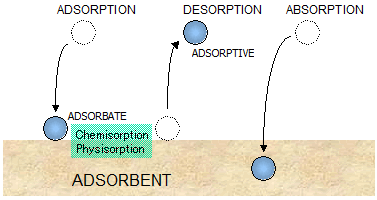
Absorption is the process in which a fluid is dissolved by a liquid or a solid (absorbent).

Adsorption is the process in which atoms, ions or molecules from a substance (it could be gas, liquid or dissolved solid) adhere to a surface of the adsorbent. Adsorption is a surface-based process where a film of adsorbate is created on the surface while absorption involves the entire volume of the absorbing substance.


Comparison Chart


Items

Absorption

Adsorption

Definition

Assimilation of molecular species throughout the bulk of the solid or liquid is termed as absorption.

Accumulation of the molecular species at the surface rather than in the bulk of the solid or liquid is termed as adsorption.

Phenomenon

It is a bulk phenomena

It is a surface phenomena.

Heat Exchange

Endothermic process

Exothermic process

Temperature

It is not affected by temperature

It is favored by low temperature

Rate of Reaction

It occurs at a uniform rate.

It steadily increases and reach to equilibrium

Concentration

It is same throughout the material.

Concentration on the surface of adsorbent is different from that in the bulk


Process

Gas-liquid absorption (a) and liquid-solid adsorption (b) mechanism. Blue spheres are solute molecules

Gas-liquid absorption (a) and liquid-solid adsorption (b) mechanis.

Blue spheres are solute molecules


Adsorption and absorption are both sorption processes.

Absorption occurs when atoms pass through or enter a bulky material. During absorption, the molecules are entirely dissolved or diffused in the absorbent to form a solution. Once dissolved, the molecules cannot be separated easily from the absorbent.

Adsorption is generally classified into physisorption (weak van der Waal’s forces) and chemisorption. It may also occur due to electrostatic attraction. The molecules are held loosely on the surface of the adsorbent and can be easily removed.


Uses


Adsorption: Some of the industrial applications for adsorption are air-conditioning, adsorption chillers, synthetic resin and water purification. An adsorption chiller does not require moving parts and hence is quiet. In pharmaceutical industry applications, adsorption is used as a means to prolong neurological exposure to specific drugs or parts thereof. Adsorption of molecules onto polymer surfaces is used in various applications such as in the development of non-stick coatings and in various biomedical devices.


Absorption: The common commercial uses of absorption cycle are absorption chillers for space cooling applications, ice production, cold storage, turbine inlet cooling. High efficiency operation, environmentally friendly refrigerants, clean-burning fuels and few moving parts that require maintenance make absorption a very good choice for consumers. 

The process of gas absorption by a liquid is used in hydrogenation of oils and carbonation of beverages.


Video Link for comparison of adsorption and absorption http://v.youku.com/v_show/id_XNjIxNzAxOTc2.html


Gold APP Instruments Corporation China


Mobile: +86-18210009838

Activated Carbon Can be Used for CH4 Storage and Transportation


Activated Carbon Can be Used for CH4 Storage and Transportation


Stored natural gas plays a vital role in ensuring that any excess supply delivered during the summer months is available to meet the increased demand of the winter months. However, with the recent trend towards natural gas fired electric generation, demand for natural gas during the summer months is now increasing (due to the demand for electricity to power air conditioners and the like). At the time, the natural gas industry noted that seasonal demand increases could not feasibly be met by pipeline delivery alone. Natural gas in storage also serves as insurance against any unforeseen accidents, political conflicts, natural disasters, or other occurrences that may affect the production or delivery of natural gas. In order to be able to meet seasonal demand increases, underground storage fields were the only option. Before the storage process, transportation takes places an important role. Scientists developed an option for gas storage and economical method for transportation of natural gas by the help of active carbon’s adsorption property. Via the high adsorption rate and capacity of activated carbon, the higher mole of methane, can be possible to store at low pressures by comparison with conventional methods.


Adsorption is the process by which molecules of a substance, such as a gas or a liquid, collect on the surface of another substance, such as a solid. The molecules are attracted to the surface but do not enter the solid's minute spaces as in absorption.


Activated carbon is a form of carbon processed to be riddled with small, low-volume pores that increase the surface area available for adsorption or chemical reactions. Activated carbon is a carbonaceous adsorbent with a high internal porosity, and hence a large internal surface area. Commercial activated carbon grades have an internal surface area of 500 up to 1500 m2/g. People studied the feasibility of storing CH4 in an abandoned coal mine and transportation of CH4 by tankers in adsorbed state using activated carbon as medium. It can be concluded that active carbon can be used for safe storage and transportation of methane as an alternative to conventional methods.


Now, we need to use good performance active carbons that help people to transport as much CH4 as possible in one time. Problem is how to know that very active carbon is suitable for us. Under this situation, we need one instrument to help us, to analysis that active carbon adsorption performance, and that instrument is HIGH PRESSURE GAS SORPTION ANALYZER.


We, Gold APP Instruments, had researched and produced high pressure gas sorption analyzer H-Sorb 2600 series by static volumetric principle. Capable of testing nanomaterials adsorption and desorption performance, PCT (pressure composition temperature) or PCI (pressure composition isotherm) curves. H-Sorb 2600 series with 2 analysis ports and 2 degassing ports, fully automated operation, supports night operation without operators watch, longest supporting test time can be last as long as half month (can be upgrade), all-featured data reports can help researchers to get all analysis details they want.


Gold APP Instruments China is a professional manufacturer for analytical and research instruments, such as BET surface area analyzers, surface area and porosity analyzers, helium true density analyzers, high pressure gas sorption analyzers and so on, to determine nanomaterials specific surface area, pore size, pore volume, pore size distribution, true density, open and closed spaces, adsorption/desorption isotherms, pressure-composition-isotherm, pressure-composition-temperature curve and so on.


Welcome visit us at www.jinaipu.com or www.app-one.com.cn to find more.

published papers

Surface Area|Pore Size|Pore Volume|Pore Size Distribution|Gas Pycnometer|Helium Density Analyzer|High Pressure Volumetric Analyzer|Powder and Porous Analysing|Laboratory Equipment|Research Instruments-Gold APP Instruments

2013年8月5日星期一

Langmuir surface area introduction--GOLD APP INSTRUMENTS

1.      The Langmuir Isotherm
Whenever a gas is in contact with a solid there will be an equilibrium established between the molecules in the gas phase and the corresponding adsorbed species (molecules or atoms) which are bound to the surface of the solid.
As with all chemical equilibria, the position of equilibrium will depend upon a number of factors :
  1. The relative stabilities of the adsorbed and gas phase species involved
  2. The temperature of the system (both the gas and surface, although these are normally the same)
  3. The pressure of the gas above the surface
In general, factors (2) and (3) exert opposite effects on the concentration of adsorbed species - that is to say that the surface coverage may be increased by raising the gas pressure but will be reduced if the surface temperature is raised.
The Langmuir isotherm was developed by Irving Langmuir in 1916 to describe the dependence of the surface coverage of an adsorbed gas on the pressure of the gas above the surface at a fixed temperature. There are many other types of isotherm (Temkin, Freundlich ...) which differ in one or more of the assumptions made in deriving the expression for the surface coverage; in particular, on how they treat the surface coverage dependence of the enthalpy of adsorption. Whilst the Langmuir isotherm is one of the simplest, it still provides a useful insight into the pressure dependence of the extent of surface adsorption.

Important Note - Surface Coverage & the Langmuir Isotherm

When considering adsorption isotherms it is conventional to adopt a definition of surface coverage (θ) which defines the maximum (saturation) surface coverage of a particular adsorbate on a given surface always to be unity, i.e. θmax = 1 .
This way of defining the surface coverage differs from that usually adopted in surface science where the more common practice is to equate θ with the ratio of adsorbate species to surface substrate atoms (which leads to saturation coverages which are almost invariably less than unity).

2.       Langmuir Isotherm - derivation from equilibrium considerations

We may derive the Langmuir isotherm by treating the adsorption process as we would any other equilibrium process - except in this case the equilibrium is between the gas phase molecules (M), together with vacant surface sites, and the species adsorbed on the surface. Thus, for a non-dissociative (molecular) adsorption process we consider the adsorption to be represented by the following chemical equation :


for further details, pls email to GOLD APP INSTRUMENTS

What Is Adsorption--GOLD APP INSTRUMENTS


What Is The Difference Between Pore Size and Pore Size Distribution

Whereas pore size is a measure of the diameter of the largest pore, pore size distribution is a measure of the range of pore sizes. The range of pore sizes can be normally distributed, and the spread can be quite narrow (e.g. the ratio of largest to smallest may be less than 2). On the other hand, pore size distribution can be very heterogeneous. In the case of large spreads and heterogeneity, the pore size will be far less predictive of flow rate (either filtration or capillary) than it will be for a membrane with a narrow pore size distribution. It is important to note that the pore size corresponding to the bubble point is not at the middle of the distribution, but is the largest pore.


2013年7月17日星期三

Porosity in Natural Soils--by GOLD APP INSTRUMENTS

 The porosity of a soil depends on several factors, including (1) packing density, (2) the breadth of the particlesize distribution (polydisperse vs. monodisperse), (3) the shape of particles, and (4) cementing. Mathematically considering an idealized soil of packed uniform spheres, φ must fall between 0.26 and 0.48, depending on the packing. Spheres randomly thrown together will have φ near the middle of this range, typically 0.30 to 0.35. A sand with grains nearly uniform in size (monodisperse) packs to about the same porosity as spheres. In a polydisperse sand, the fit-ting of small grains within the pores between large ones can reduce φ, conceivably below the 0.26 uniform-sphere minimum. Figure 2 illustrates this concept. The particular sort of arrangement required to reduce φ to 0.26 or less is highly improbable, however, so φ also typically falls within the 0.30-0.35 for polydisperse sands. Particles more irregular in shape tend to have larger gaps between their nontouching surfaces, thus forming media of greater porosity. In porous rock such as sand-stone, cementation or welding of particles not only creates pores that are different in shape from those of particulate media, but also reduces the porosity as solid material takes up space that would otherwise be pore space. Porosity in such a case can easily be less than 0.3, even approaching 0. Cementing material can also have the opposite effect. In many soils, clay and organic substances cement particles together into aggregates. An individual aggregate might have a 0.35 porosity within it, but the medium as a whole has additional pore space in the form of gaps between aggregates, so that φ can be 0.5 or greater. Observed porosities can be as great as 0.8 to 0.9 in a peat (extremely high organic matter) soil.

Porosity is often conceptually partitioned into two components, most commonly called textural and structural porosity. The textural component is the value the porosity would have if the arrangement of the particles were random, as described above for granular material without cementing. That is, the textural porosity might be about 0.3 in a granular medium. The structural component represents nonrandom structural influences, including macropores and is arithmetically defined as the difference between the textural porosity and the total porosity.

The texture of the medium relates in a general way to the pore-size distribution, as large particles give rise to large pores between them, and therefore is a major influence on the soil water retention curve. Additionally, the structure of the medium, especially the pervasive-ness of aggregation, shrinkage cracks, worm-holes, etc. substantially influences water retention.


V-Sorb 4800P surface area and particle size analyzer

Microporo analysis--by GOLD APP INSTRUMENTS

There are t-plot, HK, SF, DR-plot, NLDFT and GCMC method for the evaluation of micropore. t-plot and DR-plot are used to determine the pore volume and separation of internal and external surface area of the particle. HK, SF, NLDFT and GCMC method are used to determine the pore size distribution.

Since the micropore analysis theories must describe the short-range interaction of adsorbate and pore wall, it is not as easy as describing the flat surface adsorption or mesopore adsorption. The typical assumption of these theories is that the pore shape is a slit or cylinder. As the parameters, the surface atoms of pore wall and adsorbate molecules must be selected (e.g. oxygen/carbon, N2/Ar). If the sample has uniform and homogeneous pores, the calculated pore size will be accurate. However, most of real materials have nonuniform and heterogeneous pores which are not fit to the assumption of the theories. This disagreement is true not only for the pore size distribution obtained from the gas adsorption but also for other porosimetry and particle size measurement. The gas adsorption so far is the best method for the evaluation of micropores compared to other methods because the probe gas molecule size is below nm to detect micropores.


Our recommend method of micropore analysis is as follows: For zeolitic materials, measure them with the Ar adsorption isotherm at 87K and analyze by the cylindrical pore model theory (SF, NLDFT, and GCMC). N2 molecules, which have strong quadrupole moment, strongly attract to the cation sites and OH group on the surface. For activated carbon materials, they are often measured with N2 adsorption isotherm at 77K and analyzed by the slit pore model theory (HK, NLDFT, and GCMC).